
New Haven County Criminal History Checks
New Haven County has no county clerk, sheriff, or county jail database. Connecticut ended operational county government, so records are split among municipal police departments and state agencies. Begin with the Connecticut Judicial Branch Criminal and Motor Vehicle Case Look-up when the question concerns a pending charge, conviction, court date, or docket. Choose the defendant-name route when no docket number is known. Use the docket route for the closest match once a case number is available.
The web display is a lead, not the official court record. Names can match more than one person, and public entries may change after correction, erasure, or pardon. Check the court location, charge, and status before drawing a conclusion. For a certified file, contact the clerk at the courthouse shown on the docket. For a statewide Connecticut conviction history tied to a name or fingerprints, use the State Police Bureau of Identification instead.
- Choose pending cases, convictions, or the daily docket based on the question.
- Search by defendant name, or use the exact docket number when known.
- Match the court, charge, status, and case number rather than relying on the name alone.
- Ask the listed Superior Court clerk for the official file or a certified copy.
- Use SPBI for an official Connecticut conviction-history response rather than a court-only view.
Four New Haven County Record Custodians
A police report, court docket, repository response, and custody profile answer different questions. The arresting police agency owns the incident or arrest report. The Connecticut Superior Court creates a docket after charges are filed. SPBI compiles reported Connecticut conviction history. The Connecticut Department of Correction tracks people in state custody. Searching one source cannot reliably replace the other three.
| Record | Custodian | Best use |
|---|---|---|
| Incident or arrest report | Originating city or state police | Details recorded by the investigating agency |
| Criminal docket | Connecticut Judicial Branch | Filed charges, events, disposition, and sentence |
| Conviction-history response | SPBI Criminal Records Unit | Official Connecticut repository search |
| Custody profile | Connecticut DOC | Current state custody and sentence information |
Where fingerprints are taken, the arrest event can flow to SPBI. Court events and final dispositions later update criminal history, while the police narrative remains with its source agency. That split explains why two official searches can show different slices of the same matter.
Official Background Checks in Connecticut
The State Police Bureau of Identification offers three Connecticut-only products. A $36 name and date-of-birth search reports whether a record exists, but does not provide the record. A $75 name and date-of-birth conviction-history search supplies a copy if one exists. A $75 fingerprint conviction-history search offers stronger identity matching. These are Connecticut checks, not nationwide searches, and their scope should not be confused with a police report or court file.
General mail requests go to SPBI at 1111 Country Club Road, Middletown, CT 06457-2389. The published instructions require separate exact payments and do not permit email, fax, drop-off, or pickup. Fingerprint capture at a DESPP location costs another $15 and requires an appointment. A local police agency may provide Livescan after the requester completes the correct pre-enrollment path.
| SPBI product | Fee | Result |
|---|---|---|
| Name and date-of-birth search | $36 | Confirms whether a Connecticut record exists |
| Name-based conviction history | $75 | Provides a conviction-history copy if found |
| Fingerprint conviction history | $75 | Uses fingerprints for stronger identity matching |
| DESPP fingerprint capture | $15 | Separate appointment-only capture fee |
The official SPBI service page publishes the product scope and request rules.
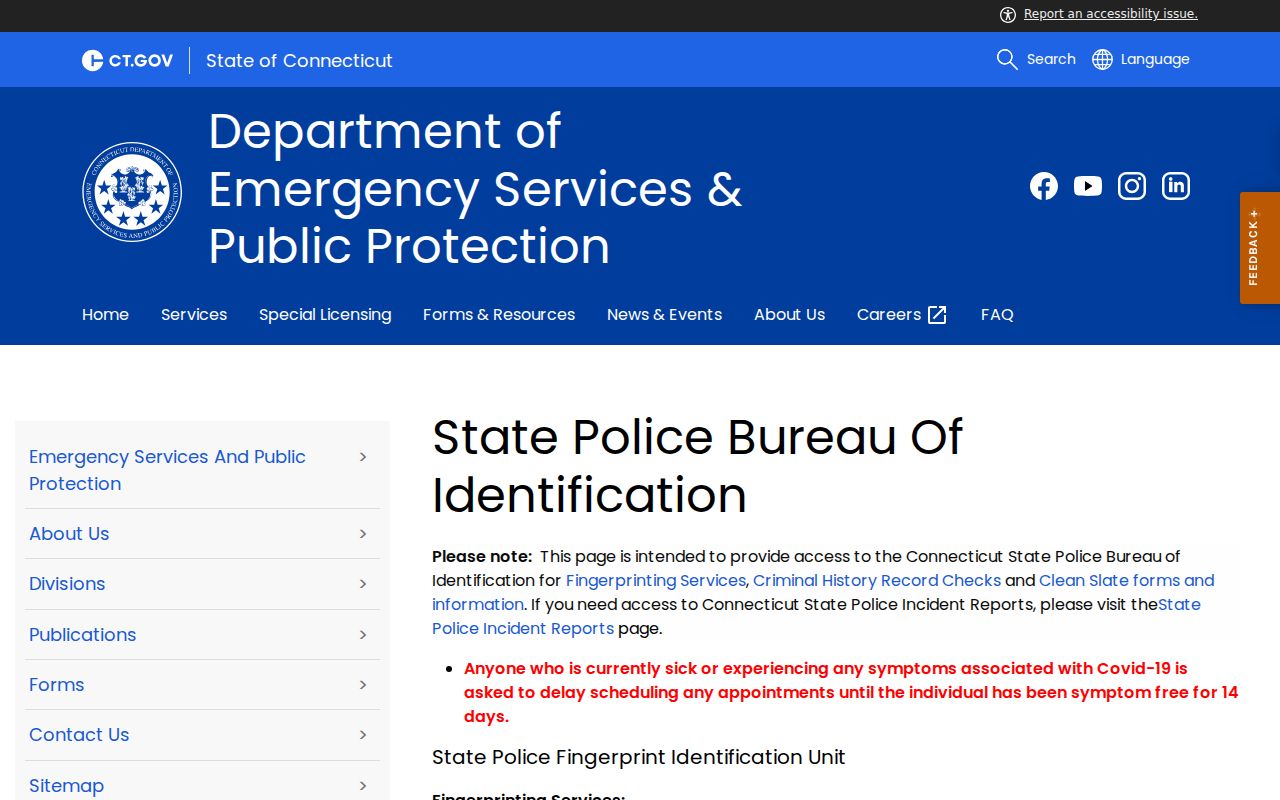
Its separate products show why the fee and search method must match the kind of response a requester needs.
New Haven County CCHRS Fingerprint Records
The Connecticut Criminal History Request System handles pre-enrollment for specified fingerprint services. A requester selects the service tied to the official purpose, completes registration, and prints the generated barcode before visiting a police department for Livescan. If the department lacks Livescan, the official pardon instructions allow a hard-copy fingerprint card to be mailed with the barcode and request form to SPBI.
The Board of Pardons and Paroles uses service code 96E0-A9E5 for a person obtaining their own rap sheet for an absolute-pardon application. Its instructions also say the SPBI report must be dated within one year of that application. Service codes are purpose-specific, so a code should come from the agency requiring the check rather than from guesswork.
The official CCHRS portal page shows where that pre-enrollment begins.
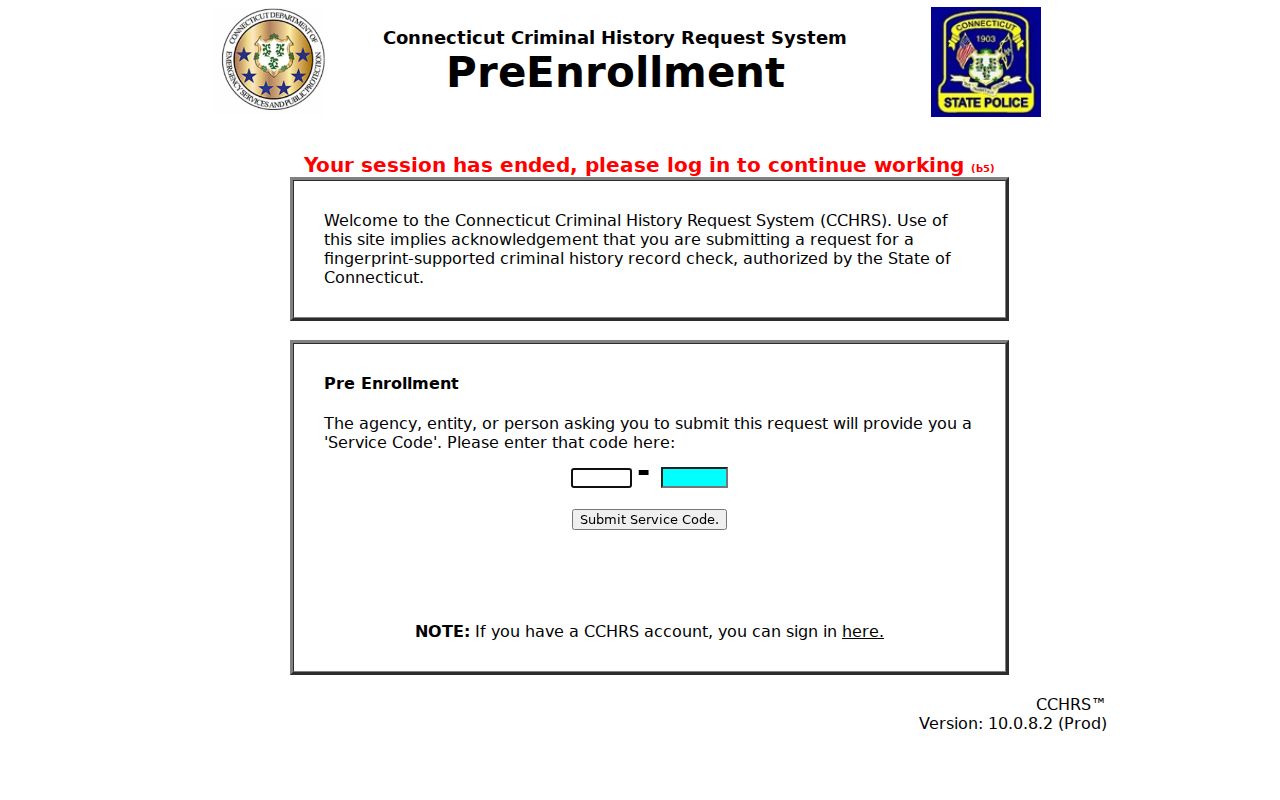
The portal is the enrollment step; it does not turn a court lookup into a fingerprint-based repository report.
Kinds of Criminal Records
New Haven County criminal records are not one file. A city police department creates an incident report and arrest paperwork. Superior Court records show charges filed in court, pleas, motions, decisions, and sentences. SPBI conviction history pulls from the state repository. Warrants have their own Judicial Branch route. Probation is run by the Judicial Branch, parole by the Board of Pardons and Paroles, and prison custody by Connecticut DOC.
- Police files contain the originating agency's report and arrest details.
- Court case files track filed charges and the case outcome.
- Repository responses report the result of the selected Connecticut criminal-history product.
- Custody files show state correction information, not a county booking log.
- Registry records are public profiles maintained under Connecticut registration law.
The full New Haven County arrest search explains why an arrest record and conviction record can differ. A docket can also outlast or update the first police account.
No New Haven County Jail Roster
There is no New Haven County sheriff or county jail roster. A municipal police department may hold a person briefly after arrest, but Connecticut DOC takes custody after the state process calls for a correctional placement. The Connecticut DOC Offender Information Search is the official statewide route for a person in DOC custody. It is not a feed of every recent city arrest.
New Haven Correctional Center is a state facility, not a county jail. It serves primarily as a pretrial center for adult men and also houses sentenced people. When someone cannot be found in the DOC search soon after an arrest, check the arresting police department and the daily court docket first. Transfer timing and data updates may place the record in different systems at different stages.
The Connecticut Department of Correction source shows the state agency responsible for custody.
That statewide custody role is why a county-branded inmate search would be the wrong starting point in New Haven County.
New Haven County Criminal Records: What They Contain
The fields depend on the record. A court display can show the docket number, court, charges, status, events, disposition, and sentence when those items are public. A police file may show the agency, event date and place, alleged offense, and arrest details. SPBI does not publish a full public data dictionary for every rap-sheet field, so repository contents should be described with care. The $36 product does not disclose a record at all; it only reports whether one exists.
| Name and identifiers | Details used to distinguish the named person, subject to the source's public display. |
|---|---|
| Arrest information | Originating agency, event date or location, alleged offense, and arrest details. |
| Charges and statutes | Allegations recorded by police or charges filed in court, which may not match. |
| Disposition | The result for a charge, such as conviction, dismissal, acquittal, or nolle. |
| Sentence | The court order imposed after conviction, when publicly displayed. |
| Custody or supervision | DOC, probation, parole, or special-parole status in the relevant system. |
Juvenile and Youthful Offender matters are not shown in the public conviction lookup. Erased records are removed from public disclosure under Connecticut law. An empty result therefore does not prove that no event ever took place.
New Haven County Criminal Court Geography
New Haven County court files belong to the statewide Connecticut Superior Court system. The New Haven Judicial District courthouse at 235 Church Street handles Judicial District and serious Part A matters. New Haven G.A. 23 at 121 Elm Street handles geographical-area criminal and motor-vehicle matters. Meriden G.A. 7 at 54 West Main Street serves the Meriden area. Waterbury matters use G.A. 4.
New Haven Judicial District
235 Church Street
New Haven, CT 06510
203-503-6800
New Haven G.A. 23
121 Elm Street
New Haven, CT 06510
203-789-7461
Meriden G.A. 7
54 West Main Street
Meriden, CT 06451
203-238-6130
The docket's court location determines which clerk holds the official file. At 235 Church Street, the first-floor Court Service Center has public computers and court-resource help. Its phone is 203-503-6819, and it is generally open weekdays from 8:30 a.m. to 5 p.m.
Connecticut Public Access Laws
The Connecticut Freedom of Information Act generally gives access to records maintained by public agencies unless another law creates an exemption. It does not make every police file, court file, erased record, or repository entry public. Courts apply Judicial Branch access rules, while police requests go to the agency that holds the report. Criminal-history dissemination and erasure laws further limit what may be disclosed.
Key Statutes:
CGS §1-210 generally provides prompt inspection or copying of public agency records, subject to exemptions.
CGS §1-212 governs copies, fees, and public-agency copying duties.
CGS §54-142g defines criminal-history record information for dissemination rules.
CGS §54-142a governs erasure after qualifying outcomes, pardons, and Clean Slate relief.
A request should name the record, date range, incident or docket number if known, and preferred delivery method. The agency may withhold exempt material or ask for clarification. A court clerk, police records unit, and SPBI are not interchangeable FOIA destinations.
The official Connecticut General Statutes index provides the source text for these access rules.
The statutes set the boundaries, while the office holding the record controls the practical request route.
New Haven County Municipal Police Records
New Haven, Waterbury, and Meriden police departments keep the reports created by their officers. New Haven Police accepts report requests through its records process and lists a $0.50 per-page report-copy charge, plus a $5 fee for a CD or other electronic media when needed. Waterbury routes public-record requests through GovQA. Meriden Police has its own Records Division. A request to a state court cannot supply the city officer's full narrative.
Connecticut FOIA is not a universal key. A police agency may withhold records or portions covered by a lawful exemption, and qualifying erased material is not open to the public. If the goal is to trace what happened after an arrest, pair the originating police response with the Judicial Branch docket. The police report describes the event from that agency's file; the court record shows what prosecutors filed and how the case moved.
New Haven County Warrants and Dockets
The Judicial Branch criminal lookup landing page includes an Arrest Warrants route. Warrant information can also surface through the court tied to a case. A municipal arrest report, however, is still requested from the police agency that made the arrest. The safest path is to use the warrant route for public court information, then contact the appropriate clerk or police records unit when an official document is needed.
Do not treat an online name match as a command to confront anyone. A person checking their own possible warrant should work through the court or counsel. Public displays change, and some warrant information may be restricted for safety or investigative reasons. The court can explain where the case is assigned, while the police agency can address its own report.
Restricted, Sealed and Erased Records
Connecticut uses the term erasure. Under CGS §54-142a, qualifying records may be erased after an acquittal, dismissal, specified nolle period, absolute pardon, or Clean Slate relief. Erasure reaches qualifying police, prosecutor, and court records. Juvenile and Youthful Offender matters are also outside the ordinary public conviction display. A missing web case can therefore reflect law, not a search failure.
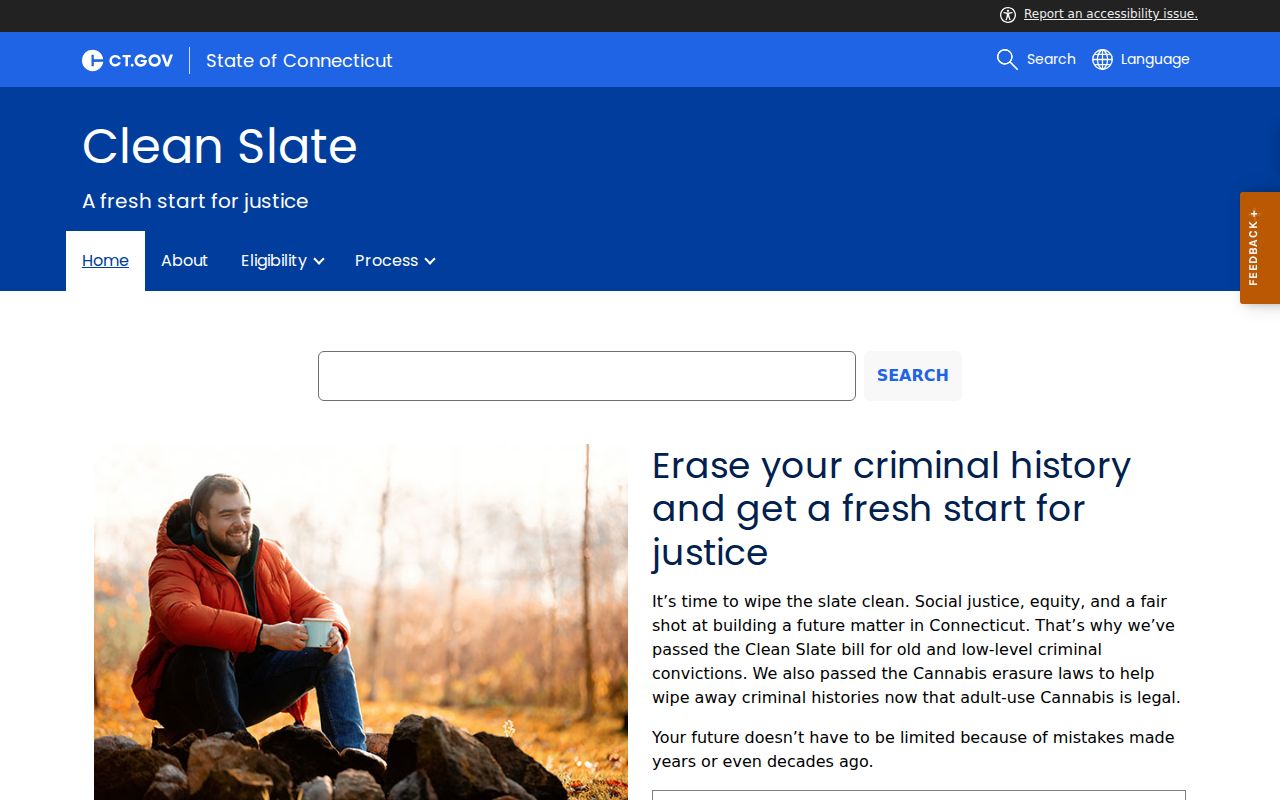
Clean Slate covers eligible convictions through automatic or review-based processes set by statute. Eligibility turns on the offense and other conditions, so official Connecticut Clean Slate information should guide a person reviewing their own record. An absolute pardon also leads to erasure under Connecticut law.
The state's Clean Slate page is the direct source for current implementation information.
Because erased material is removed from ordinary public access, older copies should not be treated as the current official record.
New Haven County Probation Records
Adult probation is state-run through the Connecticut Judicial Branch Court Support Services Division. The New Haven Adult Probation office is at 867 State Street, New Haven, CT 06511, and its public number is 203-789-7876. Probation follows a court sentence and is distinct from state prison custody. A court docket may show the sentence, while the probation office handles supervision.
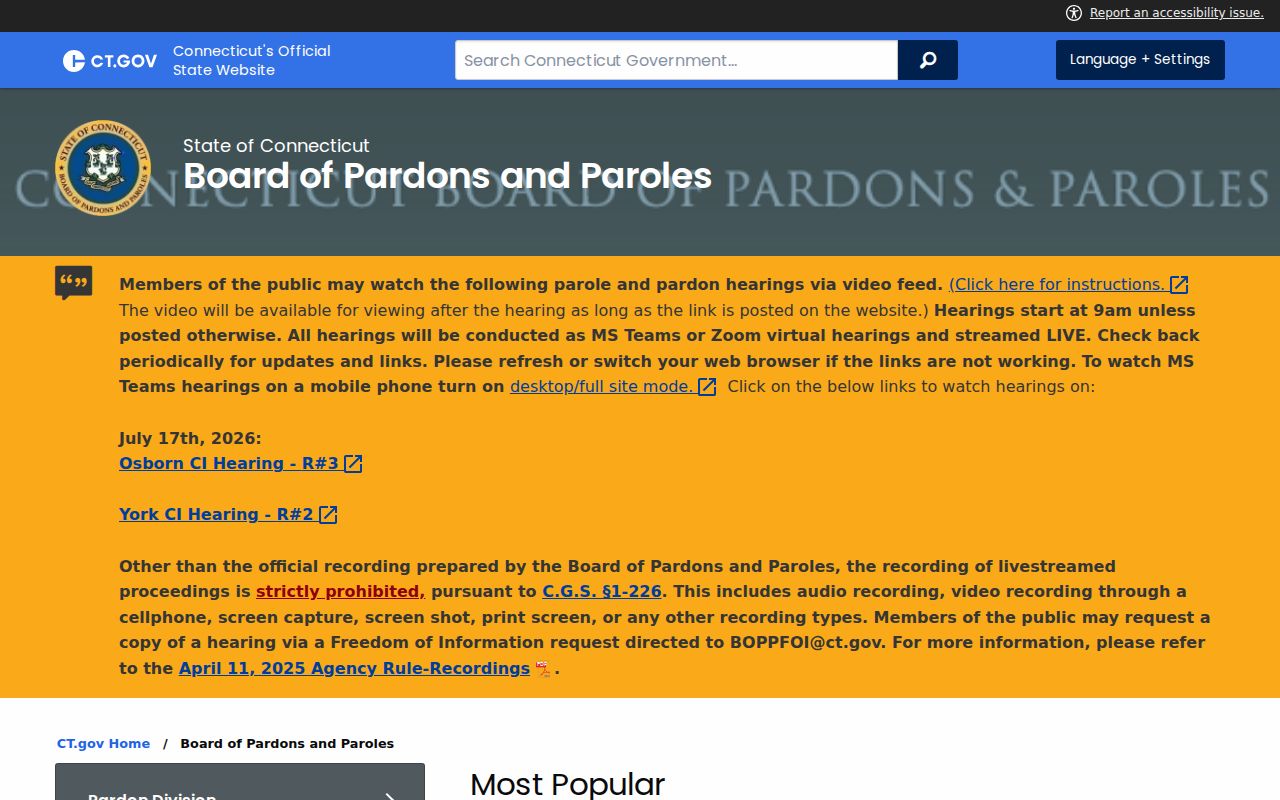
Parole is handled by the Connecticut Board of Pardons and Paroles. Special parole can also appear as part of a sentence under Connecticut law. These forms of supervision should not be guessed from a police report. Verify a court-imposed term in the official case file and use the responsible state agency for current supervision questions.
The Board of Pardons and Paroles page identifies the state authority for pardon and parole work.
That separation helps prevent a probation entry, parole status, and DOC custody record from being read as the same thing.
Reading New Haven County Record Terms
Connecticut court terms carry precise meanings. Reading them in plain language prevents a pending charge, dismissed count, or supervision term from being mistaken for a conviction.
- Geographical Area
- A Superior Court location handling criminal and motor-vehicle matters from assigned towns.
- Part A
- The Superior Court criminal part generally assigned the most serious matters.
- Nolle
- A prosecutor's decision not to pursue a charge at that time; qualifying records are generally erased after thirteen months.
- Disposition
- The result recorded for a charge, such as conviction, dismissal, acquittal, or nolle.
- Certified copy
- A clerk-attested official copy, unlike the public web display.
Pending means that no final disposition has been entered. A bond or promise to appear concerns release and attendance, not guilt. A sentence follows conviction, while probation and special parole describe different forms of supervision.
City-by-City Criminal Records in New Haven County
New Haven, Waterbury, and Meriden are the three most populous incorporated cities in New Haven County. Each police department keeps its own incident and arrest files, while criminal cases proceed in the state Superior Court system. The city pages focus on the local request office, police channel, and court route rather than pretending that a county office holds all three.
New Haven Record Check
New Haven Police records and cases routed through G.A. 23 or the Judicial District.
Waterbury Record Check
Waterbury Police requests use GovQA, with court matters routed to G.A. 4.
Meriden Record Check
Meriden Police Records Division files connect to criminal cases at G.A. 7.