
Criminal Court Cases in New Haven County
Connecticut, rather than county government, administers the Superior Court. New Haven County therefore has no county criminal clerk or separate county case portal. The New Haven Judicial District courthouse at 235 Church Street is the local Judicial District and Part A records hub for more serious matters. Its chief clerk and public information line is 203-503-6800. Geographical Area 23, at 121 Elm Street, handles criminal and motor-vehicle matters assigned to that area and answers at 203-789-7461. Meriden-area matters can appear at G.A. 7, 54 West Main Street, whose clerk number is 203-238-6130.
The location shown on a docket controls where to ask for the file. A city of arrest alone does not identify the courthouse with certainty. Clerks maintain the official pleadings, orders, docket entries, disposition, and sentence. The statewide public display is a finding aid, not a substitute for those records.
New Haven County court case numbers and court labels should be copied exactly when requesting a file. A small error can route a caller to the wrong counter or produce a weak name match. The court location also separates a state matter from a federal prosecution. Municipal police do not keep the final Superior Court file merely because they made the arrest.
New Haven Court Geography Matters
Two criminal courthouses sit within a few blocks in downtown New Haven. G.A. 23 and the Judicial District building are not interchangeable counters. The docket or notice should identify the assigned location. Meriden cases add a third local route at G.A. 7. Calling the listed clerk before travel is useful for archived material, certified copies, and cases missing from the public display.
The Judicial Branch location page confirms the New Haven Judicial District courthouse and access details. That office is open to the public from 9 a.m. to 5 p.m., with doors opening at 8:30 a.m. Use the specific court page or statewide directory to confirm current logistics.
The official courthouse view helps a reader recognize the correct state records hub.
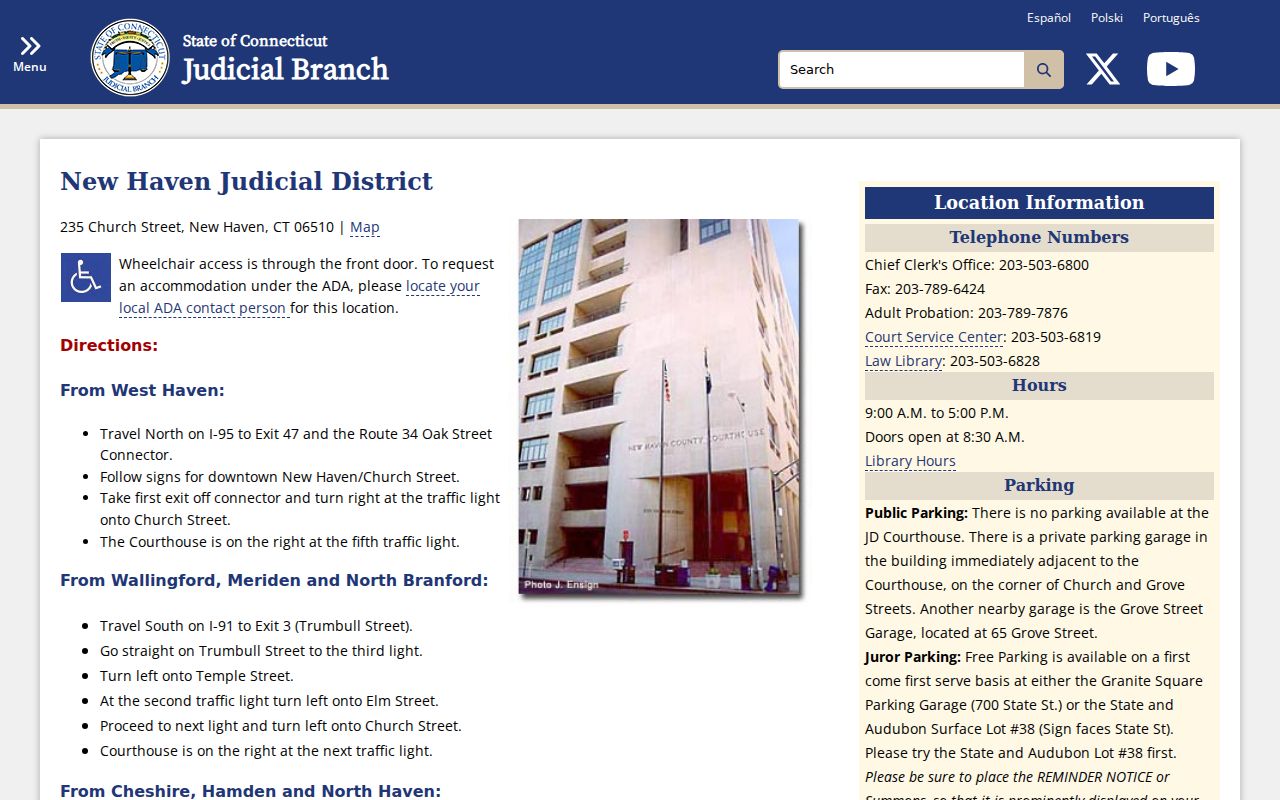
Its location data should be matched to the court named on the case result.
New Haven County Case Record Searches
The free Connecticut Judicial Branch Criminal and Motor Vehicle Case Look-up separates pending cases, convictions, and daily dockets. A docket number is the most exact key. Name searches are useful when the number is unknown, but matching names require care. The Judicial Branch warns that its pages are a public service and not the official court record.
- Open the criminal and motor-vehicle lookup landing page.
- Choose pending case, conviction, or daily docket based on the question.
- Select the defendant-name or docket-number route offered for that category.
- Read the court location, charges, status, events, disposition, and sentence that are publicly shown.
- Contact the named clerk for the official file or a certified copy.
| Field Label | Type | Required | Notes |
|---|---|---|---|
| Convictions by Defendant | Route link | No | Name-based conviction display |
| Convictions by Docket Number | Route link | No | Exact docket route |
| Pending Case by Defendant | Route link | No | Name-based pending case route |
| Pending Case by Docket Number | Route link | No | Exact pending docket route |
| Daily Docket by Court or Defendant | Route link | No | Calendar and appearance routes |
New Haven Court Service Center
A web search is not the only access channel. The Court Service Center sits on the first floor at 235 Church Street and provides public computers plus court-resource help. Its published phone is 203-503-6819, and its general weekday hours are 8:30 a.m. to 5 p.m. The center is a practical fallback when a reader lacks home access or needs help finding the right court resource.
Clerk staff remain the source for official copies and certification. Ask whether an older file is stored off-site, whether the requested document is public, and what current copy or certification charge applies. The assigned official sources did not publish a reliable fee, so no fixed amount should be assumed.
New Haven Court Service Center
235 Church Street, first floor
New Haven, CT 06510
203-503-6819
Weekdays, generally 8:30 a.m.–5 p.m.
What a Criminal Case File Contains
A New Haven County criminal case file follows the prosecution after charges are filed. It can answer questions an arrest report cannot, including which counts reached court, what happened at hearings, and how each filed charge ended. Public web fields vary, and the clerk's file may contain more releasable material than the online view.
| Case Number & Court | Unique docket identifier and assigned Superior Court location. |
|---|---|
| Charging Document | Counts filed for prosecution, which may differ from arrest allegations. |
| Docket Entries | Chronological filings, hearings, motions, and court action. |
| Hearing Dates | Scheduled or completed appearances shown in the public record. |
| Disposition & Judgment | Result for each charge, such as conviction, dismissal, acquittal, or nolle. |
| Sentence & Conditions | Orders imposed after conviction, where publicly released. |
Reading New Haven Case Outcomes
A disposition is the recorded result of a charge. A conviction is a judgment of guilt, including one based on a guilty plea. Dismissal ends the charge in court. An acquittal is a not-guilty judgment. A nolle prosequi, often shortened to nolle, means the prosecutor declined to pursue the charge at that time. Under Connecticut erasure law, covered nolled records are generally erased after thirteen months.
- Pending
- No final court disposition has been entered.
- Arraignment
- The first appearance where charges and release terms are addressed.
- Bond
- Release conditions or financial security ordered for appearance.
- Certified copy
- A clerk-attested official copy, unlike the web display.
One docket can contain several counts with different outcomes. Read each count, date, and status rather than reducing the file to one label.
Sentence fields also need context. A suspended sentence means imprisonment was imposed but held back in whole or part under stated conditions. Concurrent sentences run at the same time, while consecutive sentences run one after another. Probation is Judicial Branch community supervision. Special parole is a different post-release status authorized by Connecticut law. The docket, not a guess from the charge class, supplies the actual order.
Criminal Case Stages in New Haven County
The police arrest record and the court docket begin at different points. Police document the alleged event and original arrest charges. A prosecutor then decides what to file. The Superior Court records arraignment, pretrial proceedings, a plea or trial, the outcome, and any sentence. Charges may be added, reduced, substituted, or declined along the way.
Case flow: Charges Filed › Arraignment › Pretrial › Plea or Trial › Disposition › Sentencing
That sequence explains why an New Haven County arrest search and a court case lookup can show different charge labels without either record being mistaken. Preserve the source and date when comparing them.
New Haven Charging Records
Connecticut has no elected county district attorney. The Division of Criminal Justice prosecutes cases through a State's Attorney for each Judicial District. The New Haven Judicial District State's Attorney operates at 235 Church Street and can be reached at 203-503-6823. DCJ expressly says it does not provide criminal-record information to the public. It directs case-status and conviction questions to the Judicial Branch and statewide criminal-history inquiries to State Police.
The official State's Attorney directory shows this state-run structure.
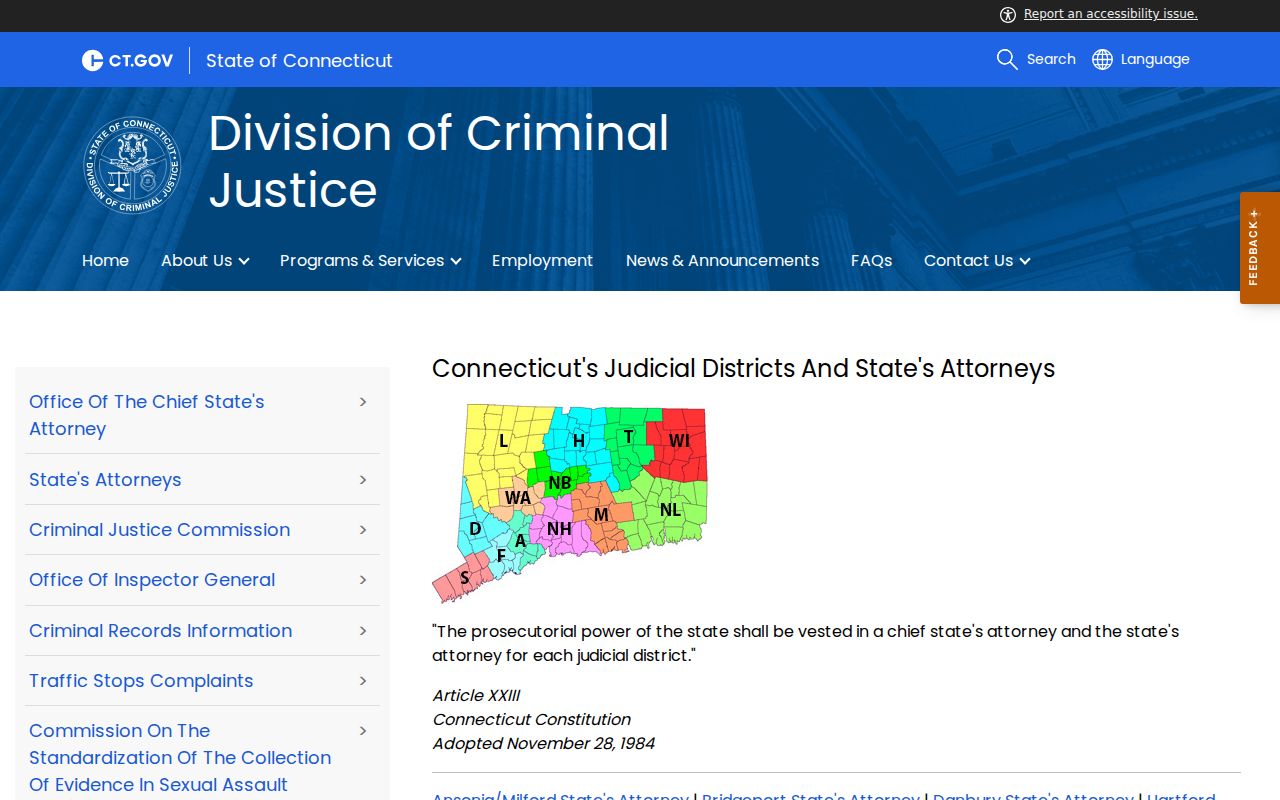
That routing helps keep prosecution offices separate from the clerk who releases court files.
New Haven Case Access Offices
The official G.A. 23 page identifies the Elm Street courthouse used for many area criminal matters.
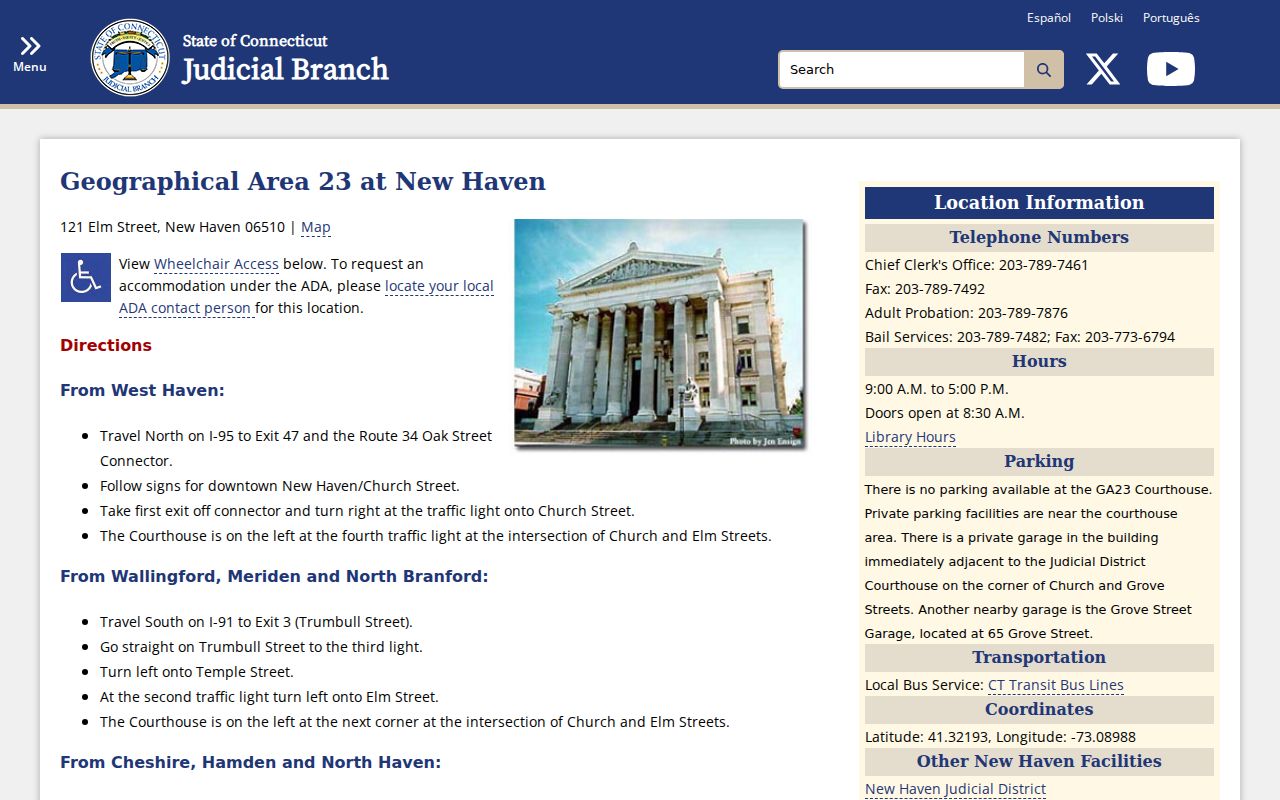
The docket's court location tells a reader whether this clerk or the Judicial District clerk holds the case.
The Public Defender judicial district directory lists defense offices but does not serve as a records search.
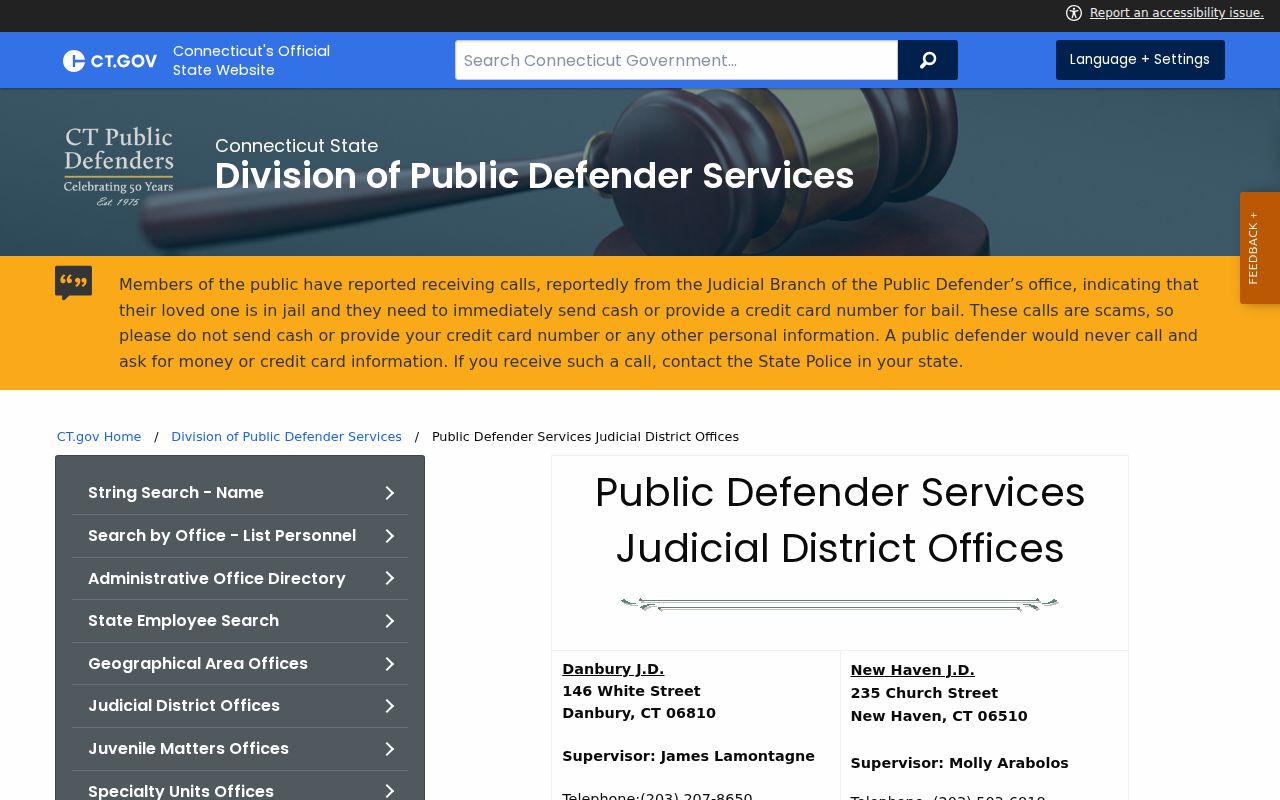
Record requests still belong with the clerk, while representation questions belong with the proper defense office.
Federal Cases in New Haven
Federal criminal matters are outside the Connecticut Superior Court lookup. They are filed in the United States District Court for the District of Connecticut. The New Haven federal courthouse is at 141 Church Street, and its Clerk's Office answers at 203-773-2140. PACER provides the nationwide federal docket system and requires registration. Connecticut state searches do not cover it.
The District Court's New Haven page supplies the official federal location and contact route.
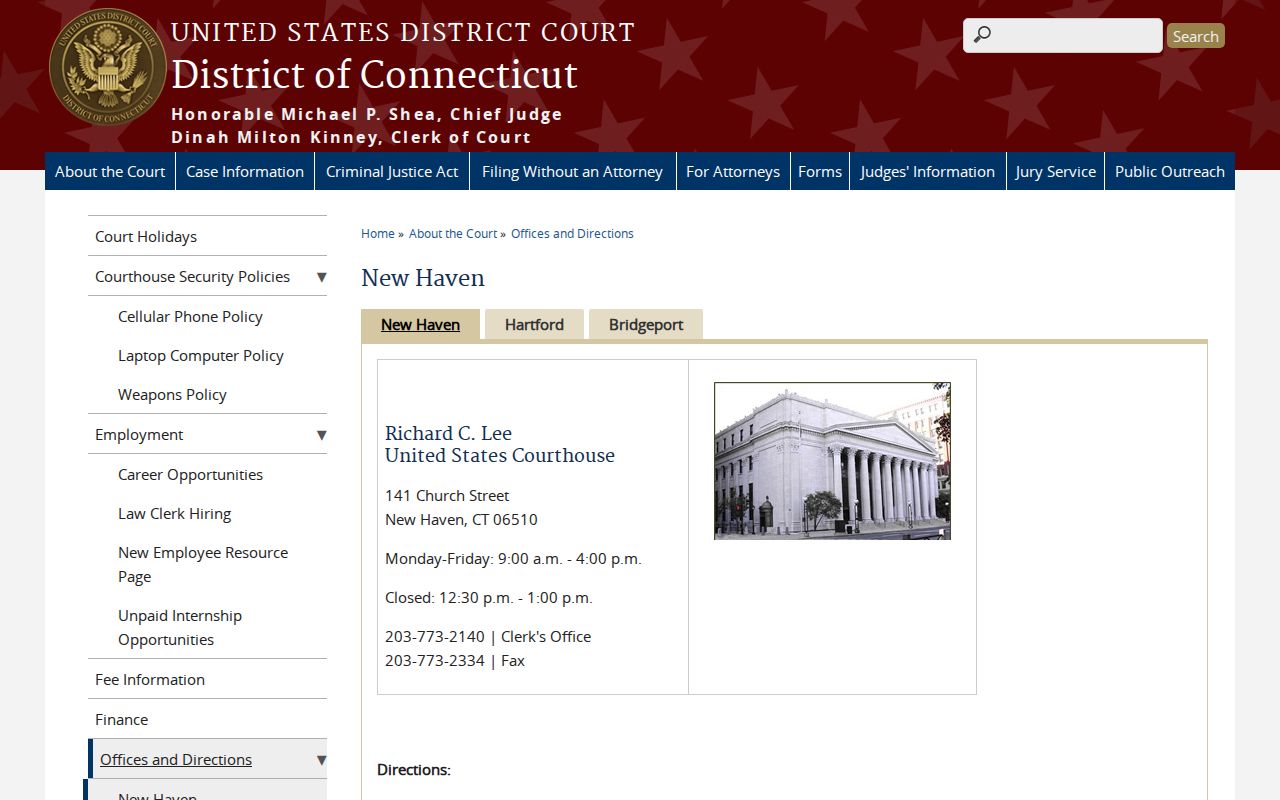
A federal calendar is not the docket, and sealed documents remain unavailable to the public.
Access Rules for Case Records
The online conviction display generally runs no more than ten years after sentencing and can be shorter under Practice Book §7-13. It excludes juvenile cases, Youthful Offender matters, infractions, and violation convictions. Corrections, pardons, erasures, and other updates can also change what appears. A blank search is not proof that no event ever occurred.
For an official answer, ask the assigned clerk about the file. Court access rules differ from an executive-agency FOIA request. Sealed or erased material, protected identities, and confidential juvenile records will not become public merely because a request is made.
The official criminal lookup page also explains its retention limits and disclaimer.
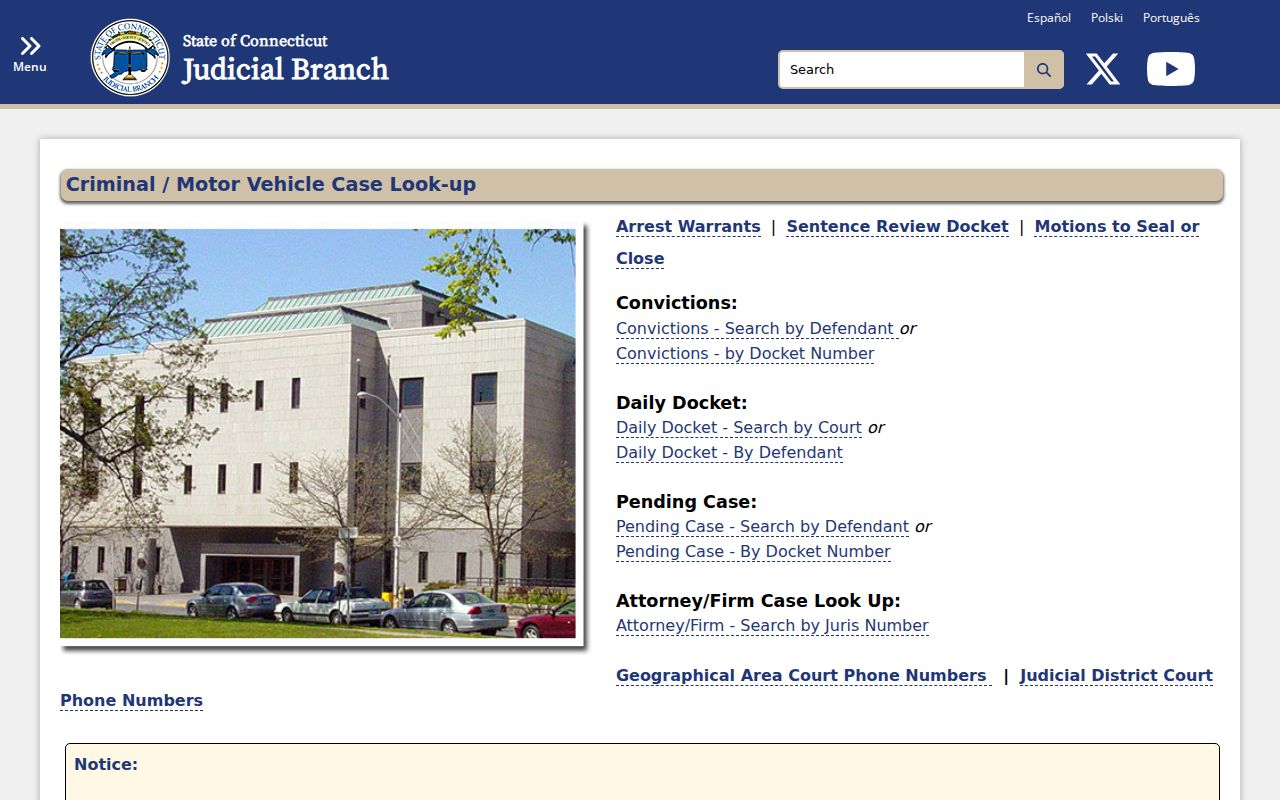
Use the displayed docket as a lead and the courthouse clerk as the final record source.
Connecticut Freedom of Information Act rules apply to executive and municipal agencies, but a court file request follows Judicial Branch access practice. This distinction matters when one event generated both a police report and a prosecution. Ask the police agency for the incident narrative and ask the court clerk for pleadings, orders, and the outcome. Neither office can turn a confidential juvenile or Youthful Offender matter into a public file.
Qualifying dismissals and acquittals are erased after the appeal period or final appellate resolution under CGS §54-142a. A covered nolle is generally erased after thirteen months. Absolute pardons and eligible Clean Slate cases can also alter public access. Mixed-count files require care because one erased count does not always mean every part of a multi-count record is open or gone. When the public display and an older paper reference conflict, the clerk and current statute provide the sound verification path.