
New Haven County Sex Offender Checks
The Connecticut Sex Offender Registry is administered by DESPP and Connecticut State Police. Registration is state-centered. There is no New Haven County sheriff list to search. The official interface can search by name, city, county, ZIP code, address, and a radius currently offered by the live form. Map and list views present the same registration data in different ways.
Begin with the strongest location or identity facts available. A surname search may find people across Connecticut, while a geographic search supports neighborhood awareness. Do not treat a last-known address as real-time location or a blank result as proof of compliance.
The state describes public information as including where a registrant resides, physical descriptors, and the place, date, and details of the qualifying offense. Search results are public safety records, not a list of every person arrested for a sexual offense. A court case can exist without a registry duty, and a registry profile does not replace the underlying court docket.
New Haven County Registry Disclaimer
The DESPP-linked search requires users to acknowledge its conditions. Those terms are substantive. Connecticut publishes information for public safety but has not assessed each registrant's individual risk of reoffense. The state does not declare that every listed person is currently dangerous.
The Connecticut registry service entry is the official starting point.
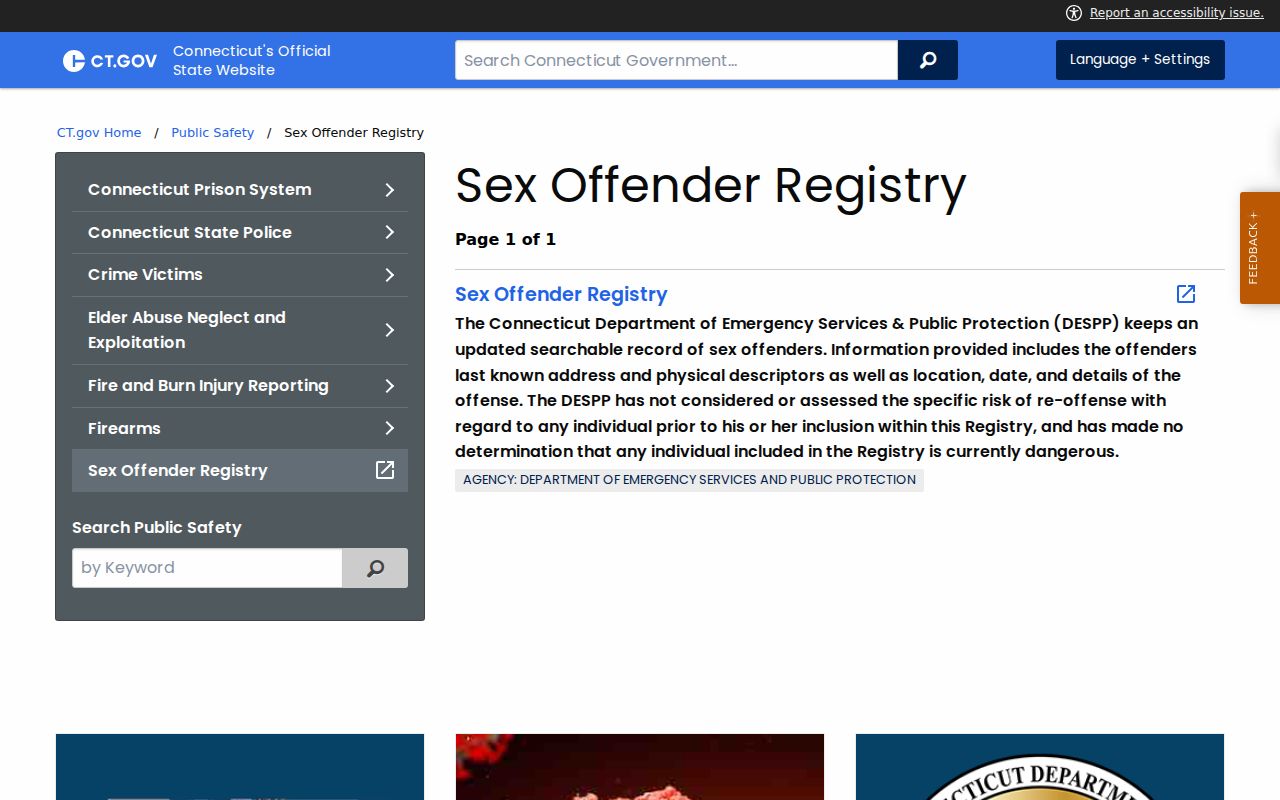
Read the state notice before opening profiles or enrolling in alerts.
New Haven County Registry Searches
The public interface is JavaScript-driven and may change. Use the controls visible at search time and do not assume a fixed radius. County filtering is available, but city, ZIP, address, and map searches may be more useful for a specific New Haven County location.
- Open the DESPP registry service and accept the official disclaimer.
- Choose a name search or a city, county, ZIP, address, or proximity search.
- Use the result list or map to identify the relevant public profile.
- Read the offense, duration, address status, descriptors, and dates in context.
| Field Label | Type | Required | Notes |
|---|---|---|---|
| Last Name | Text | No, unless name mode | Partial matching follows portal rules |
| First Name | Text | No | Narrows surname results |
| City / ZIP Code | Text or select | No | Connecticut location filters |
| County | Select | No | Includes New Haven County |
| Address / Radius | Text and select | Conditional | Choose a radius currently offered |
| Email Notifications | Enrollment link | No | Free proximity alert service |
Search New Haven County Cities
A county filter gives a broad view. For a narrower check, run separate city or ZIP searches for New Haven, Waterbury, Meriden, or another municipality. An address-and-radius search can help near city borders. The registry's email enrollment adds a continuing proximity alert rather than a one-time result.
Connecticut has no sound statewide school or park distance rule in the assigned official materials. Do not turn municipal rules or individual supervision conditions into a blanket statewide claim.
A search near a town line should use more than the town name. Address and radius tools can reveal nearby results across municipal borders. A New Haven County selection offers breadth, while ZIP and map views add local focus. Recheck the live controls because the vendor can change interface choices without rewriting the Connecticut statutes.
New Haven Registry Profile Fields
A public profile combines identity descriptors, a last-known residence, and qualifying offense information. Connecticut's administrative collection is broader than what is necessarily public. Fingerprints, DNA, Internet identifiers, and treatment records collected in specified cases should not be assumed visible.
| Name & Aliases | Published identity names associated with the record. |
|---|---|
| Photo & Description | Photograph, age or birth data, sex, race, build, hair, eyes, and marks. |
| Registered Address | Residential or last-known address, not a real-time location feed. |
| Offense & Court | Qualifying offense, conviction date, docket, and related details. |
| Identifiers | May include SPBI number, local case number, and arresting agency. |
| Registration Details | Duration plus release, probation, or parole fields when supplied. |
New Haven Registry Search with NSOPW
The U.S. Department of Justice National Sex Offender Public Website searches participating jurisdictions. It is useful near state lines or when someone may have moved. It does not replace the Connecticut source record or DESPP's correction channel.
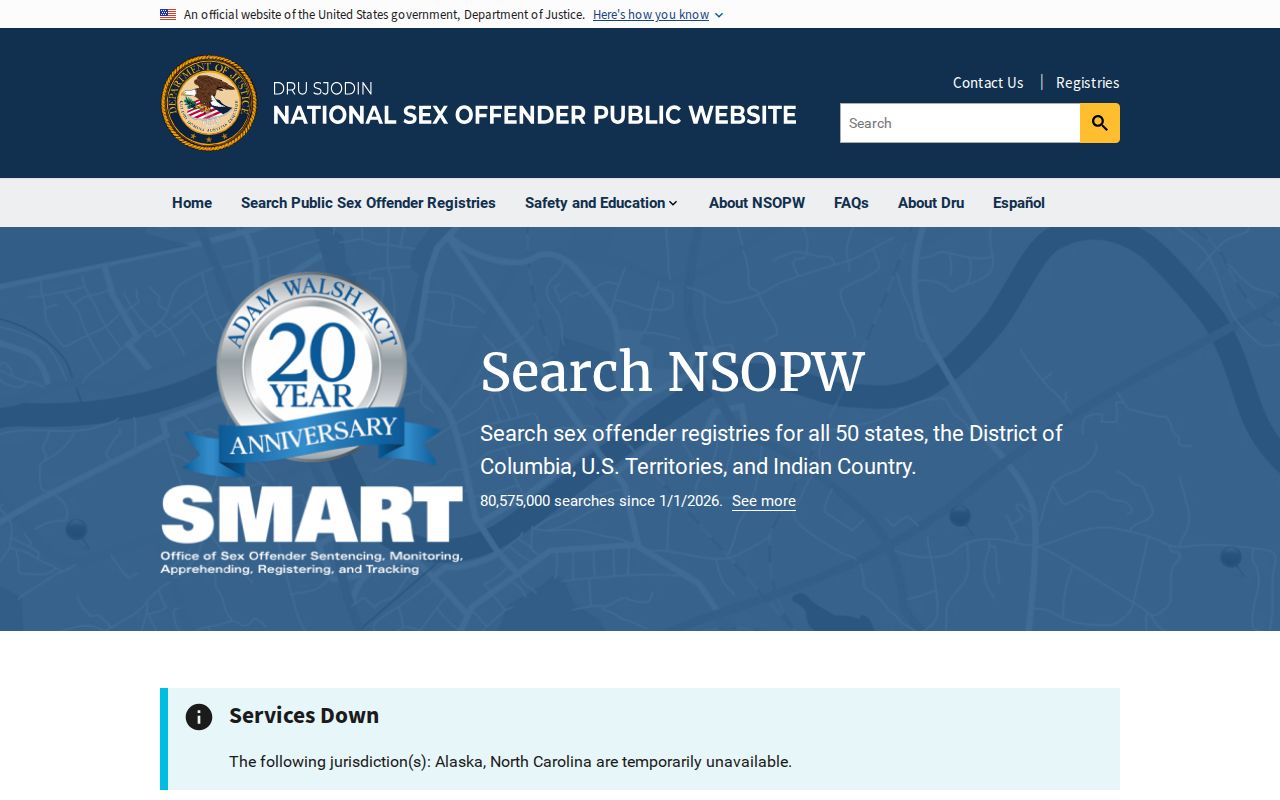
Compare jurisdiction labels and return to Connecticut's registry for the state-maintained details.
New Haven Registry Duties and Duration
Connecticut does not publish a simple Level 1, 2, or 3 risk score like some states. Duration follows the statutory offense category and history. A qualifying nonviolent sexual offense or offense against a minor generally produces ten years, while a sexually violent offense or repeat qualifying conviction can require life. The exact statute and judgment date control.
Connecticut is not compliant with the federal SORNA framework, according to the state's Office of Policy and Management. Federal Tier I, II, and III labels therefore should not be retrofitted onto Connecticut profiles. The state scheme uses its own offense categories, registration terms, exceptions, and narrowly authorized court restrictions.
| Connecticut Basis | General Duration | Public Note |
|---|---|---|
| CGS §54-251 qualifying offense | Generally 10 years | Subject to the statute and exceptions |
| Repeat qualifying conviction | Lifetime | Prior qualifying history matters |
| CGS §54-252 sexually violent offense | Lifetime | Offense-based, not a public risk tier |
| Other-jurisdiction conviction | Underlying duty applies | Connecticut comparability rules control |
| CGS §54-255 restriction | Case-specific | Narrow court authority, not a general opt-out |
Report New Haven Registry Noncompliance
Questions, apparent errors, or suspected noncompliance belong with the DESPP Sex Offender Registry Unit. The office is at 1111 Country Club Road, Middletown, CT 06457. Call 860-685-8060 or email SORU@ct.gov. Published registration business hours are Monday through Friday, 9 a.m. to 3 p.m., excluding federal and state holidays.
The Connecticut State Police service page provides the state agency route.
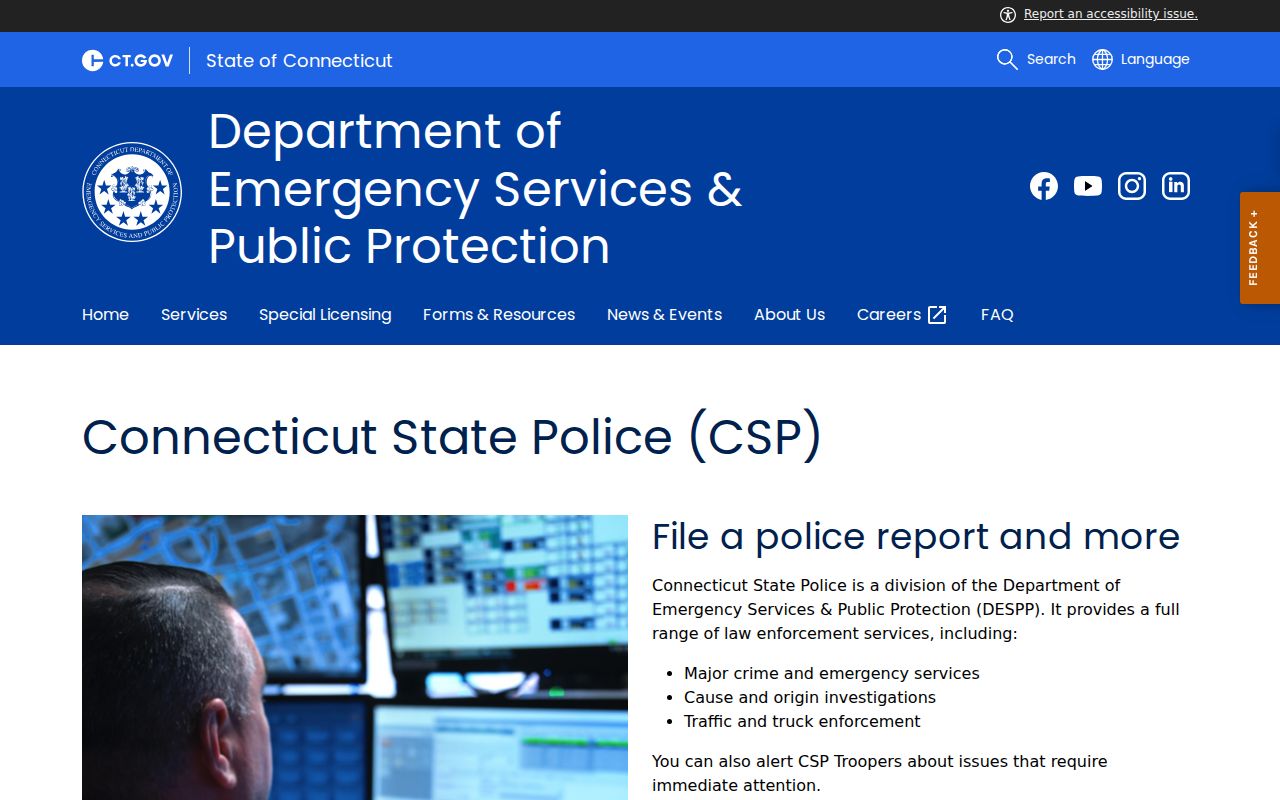
Report concerns to authorities. Do not investigate, confront, or publish accusations.
New Haven Registry Address Limits
Registry addresses are last-known information. A stale address does not prove that a person is evading a duty, and a current-looking result does not provide live location. Address verification occurs under CGS §54-257, with local police acting on failures as authorized.
The distinction matters for family and neighborhood safety. Use the profile as an official notice, enroll in proximity alerts when useful, and send suspected errors to SORU. Never infer a different conviction from registry data. Connecticut's warning states that using the registry to suggest a person committed some crime other than the listed qualifying crime is inaccurate.
Registration paperwork also requires detailed updates. The state advisement addresses a full residential street address, name and status changes, and certain travel notices. A person released to the community is generally told to report in person within three days unless another rule or order applies. Someone arriving from another jurisdiction must register without undue delay, described in the form as within five business days.
Use New Haven Registry Data Lawfully
Connecticut makes registry information public for awareness and safety planning. Local police receive registration information and may have enforcement or notification duties, while the statewide alert system offers a user-controlled way to monitor a chosen area. The information does not authorize harassment, threats, injury, discrimination, or vigilantism.
Community notification is tied to the statutory category and agency duties. Email proximity alerts give residents a direct, repeatable notification option without inviting confrontation. If a profile appears wrong, save the official page details and contact SORU. Do not post an accusation, approach a residence, or attempt to test compliance personally.
Misuse is a crime: CGS §54-258a warns that anyone using registry information to injure, harass, or commit a criminal act against a listed person or anyone else is subject to criminal prosecution.
The official Connecticut registry statutes set the access, warning, verification, and notification rules.
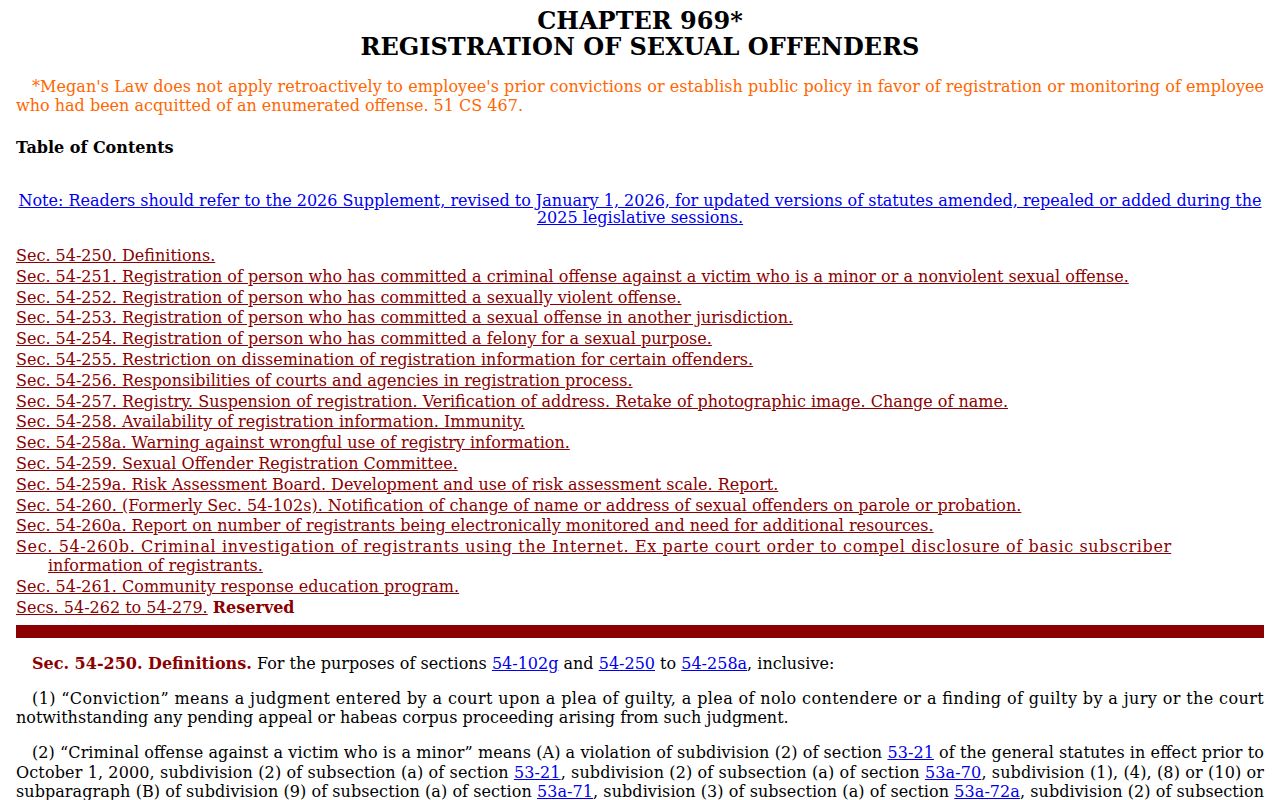
Use the statute and state registry together, and direct compliance concerns to DESPP.
CGS §§54-250 through 54-261 govern the state scheme. Section 54-258 requires public availability subject to statutory limits, while §54-258a requires the misuse warning. Section 54-257 addresses address verification. These provisions work together: public access supports awareness, agency verification supports enforcement, and the warning limits harmful conduct by searchers.
The registry should also remain separate from ordinary court research. A profile identifies the offense that created a registration duty and provides the public registration fields. It does not display every motion, hearing, charge outcome, or document from the criminal file. For that procedural history, use Connecticut Judicial Branch records and the assigned clerk. For registration corrections, use SORU. Keeping those channels distinct prevents a profile from being stretched beyond what Connecticut publishes it to show.
Public profile fields also need careful matching. Similar names are not enough. Compare the photograph, physical descriptors, aliases, date or age information, SPBI identifier where shown, qualifying offense, and address. Do not use a single matching trait to claim that two records concern the same person. The search is a public safety check, not an invitation to compile a broader personal dossier.
Connecticut's free email service supports future awareness around a chosen location. Enrollment does not guarantee that every move, status change, or enforcement event appears at once. Review the message against the current official profile, then contact the Registry Unit if key facts conflict. For urgent danger, use emergency services. For routine data questions, use SORU's published phone or email rather than approaching the listed address.